
123 Rummy Cash Tables: 7 Best Micro-Stake Pickups (2026)
123 Rummy App
10/11/2026
42.9 MB
v3.2.2
Android 5.0+
96500

Description
- 1. Calculating Buy-In Buffers in 123 Rummy Cash Tables
- 2. Comparing 2-Player Duels vs 6-Player Cash Lobbies
- 3. Reading Rake & Net Payout Clarity Before Joining
- 4. Knowing When to Stand Up & Close Cash Lobbies
- Worked ₹500 Bankroll Plan Across Cash Tables
- Reading Seat Dynamics & Timing Before Joining
- Why Bare Minimum Balance Hurts Play
- Clean Rules for Stopping Sessions and Stepping Down
- 5. Questions About Real Cash Lobby Selection
Choosing wrong table stakes drains patience faster than losing one bad hand, which makes mastering 123 Rummy Cash Tables essential before joining real-money lobbies. Beginners often scroll straight into ₹2/pt Points rooms holding only ₹200 inside Deposit Wallet, only to realize one single 80-point bad deal wipes 80 percent of their playable session balance immediately!
Understanding lobby filters and entry caps across 123 Rummy App lets players align risk comfortably inside sound bankroll limits on every 13-card rummy session. Checking minimum table cover, rake impact, and seat speed prevents avoidable panic.
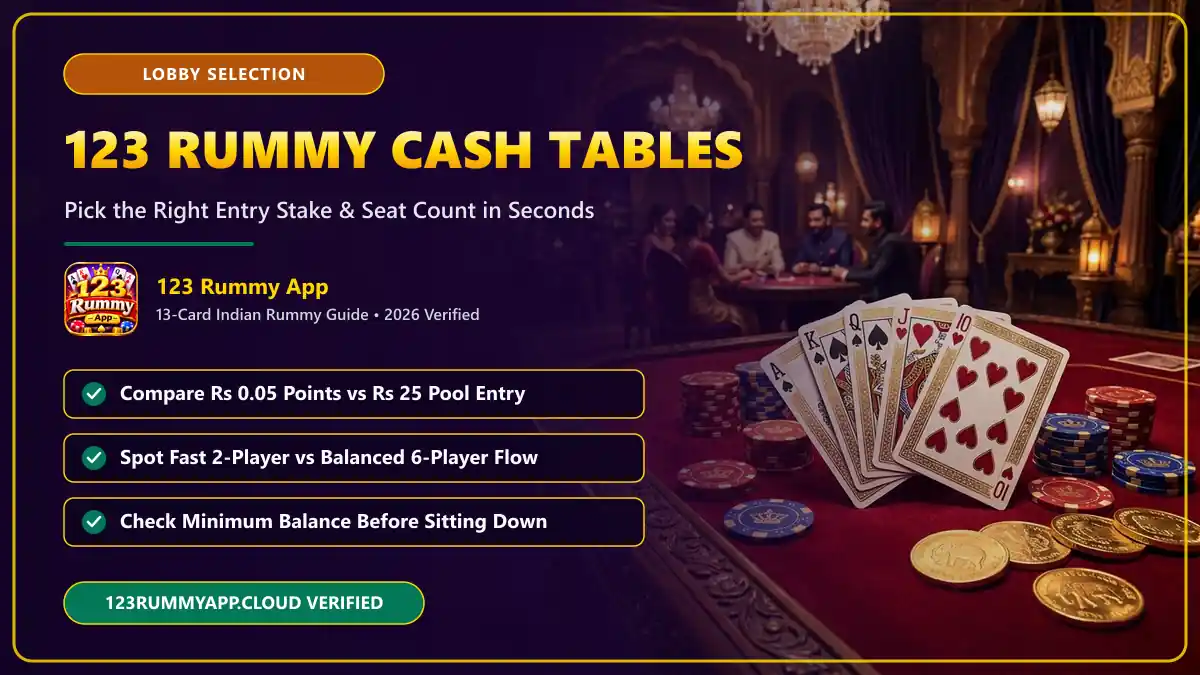
How Buy-In Caps Work Inside 123 Rummy Cash Tables
Every open seat across 123 Rummy Cash Tables displays two distinct figures before cards shuffle: the base entry or point value, and the mandatory table cover required inside your account to keep sitting smoothly. On Points rooms, platforms multiply the point value by 80 (maximum possible single-hand loss under Indian rules) so nobody walks away mid-round leaving unpaid debts to winners!
Suppose you click a ₹1/pt table inside 123 Rummy Cash Tables expecting gentle play. Immediately, the lobby checks for ₹80 minimum balance for one deal alone. Two unlucky cold deals cost ₹160 within four minutes! Contrast that against sitting inside ₹0.10/pt rooms (max ₹8 single-deal cap) or fixed ₹25 Pool rooms where your evening loss cannot exceed ₹25 unless you choose an optional Rejoin (check rejoin math here).

Picking 2-Seat vs 6-Seat 123 Rummy Cash Tables Calmly
Lobby filters let you sort rooms by active player capacity cleanly:
- 2-Player Heads-Up Rooms: Fast pacing, single-deck speed, and huge turn frequency. Every discard directly teaches your single rival what you reject, so passive waiting hurts!
- 6-Player Full Tables: Two shuffled 52-card decks plus Printed Jokers slow game rhythms down slightly while increasing prize pot sizes cleanly. First Drop discipline shines brightly here because folding a dead 65-point hand costs only 20 points while waiting for two aggressive opponents to knock each other out!
Explore complete behavioral contrast inside our 2-Player vs 6-Player tactical guide before choosing Friday night rooms.
18+ Skill Gaming Guide | Check Local State Rules Before Playing
Rake Math & Net Cash Inside 123 Rummy Cash Tables
Real-cash platforms charge a modest service fee called rake or commission taken cleanly out of winning pot totals. Understanding rake prevents false expectations when balancing session ledgers across multi-deal cash tracking! Notice how razor-thin margins operate at ultra-fast micro tables versus slightly longer Best-of-3 Deals formats.
Winning three narrow 5-point Points hands back-to-back produces small positive gains once platform fee deducts, whereas dropping smartly on terrible hands and capturing one clean 65-point declare shifts session net firmly upward. Check exact deduction behavior using our Points Calculator and confirm winning tax treatment on Section 115BBJ TDS guidance.

Smart Seat Exit Habits on 123 Rummy Cash Tables
Great card players protect profits by treating 123 Rummy Cash Tables as single controlled sessions rather than endless marathons. Never jump one stake tier upward to win back ₹100 quickly after two cold losses; tilt pushes rushed declarations into 80-point Wrong Show penalties fast.
Check state legality first on Indian state play guidelines (never risk paid lobbies inside restricted jurisdictions), lock weekly spending limits via Responsible Gaming controls, and exit calmly while your focus stays fresh.
Worked ₹500 Bankroll Ladder for 123 Rummy Cash Tables
Bankroll errors wipe out beginners faster than weak card skills. Suppose you deposit ₹500 via UPI for weekend entertainment and browse 123 Rummy Cash Tables looking for a quick game. Look at the huge survival difference between picking a ₹0.10 per point lobby versus sitting down impulsively at a ₹1 per point table with that exact ₹500 wallet.
Why the 20x Max-Loss Rule Protects Session Calm
Experienced Indian grinders follow a simple rule across 123 Rummy Cash Tables: keep at least 20 times the maximum 80-point single-deal loss sitting comfortably inside your session budget! On a ₹0.25/pt table (where 80 points equals ₹20), 20x cover equals ₹400. Having ₹500 gives you room to take disciplined 20-point First Drops (₹5 each) without sweating one unlucky Turn-4 opponent show. Sitting at ₹2/pt (80 points equals ₹160) with only ₹500 violates that rule horribly, putting you on edge every single draw (read full bankroll rules). Notice how much calmer decision-making stays when a single bad hand loses 4 percent of your wallet instead of 32 percent!
Choosing Fixed Pool or Deals vs Open-Ended Points Tables
Match your available evening clock to the right format inside 123 Rummy Cash Tables before sitting down. Suppose you only have 10 free minutes between train stops: joining a ₹0.25/pt single-deal table lets you click Leave Seat smoothly after any shuffle, whereas joining a 6-seat ₹50 101 Pool locks your entry fee for 20 minutes (compare all game modes). Conversely, if you prefer knowing your exact maximum rupee exposure before Deal 1 opens, fixed-buy-in Pool and Best-of-2 Deals lobbies protect budgets better than uncapped multi-deal Points streaks.
Evaluating Seat Flow Across 123 Rummy Cash Tables
Not every room displaying the same rupee entry plays at equal difficulty. Paying attention to lobby seat counts, time of day, and table pace before clicking Join sharpens your edge inside 123 Rummy Cash Tables.
Evening Peak Hours vs 2 AM Shark Lobbies
Between 7:30 PM and 10:30 PM IST, casual after-dinner hobbyists fill 6-player micro-stake lobbies across India. Play flows slightly looser, fewer players track every middle discard, and recreational pacing stays relaxed. After midnight past 1:00 AM IST, casual crowds log off, leaving mostly tired grinders and disciplined regulars sitting inside fast 2-player duels! Unless you feel completely alert, skipping late-night high-speed rooms avoids costly fatigue mistakes (see late-night error math).
Reading Table Speed Before Committing Cash
Notice how 2-player cash lobbies deal twice as many hands per hour as 6-player lobbies (compare 2-player vs 6-player dynamics). Higher hands-per-hour multiplies both variance and platform rake turnover! Beginners protecting small balances usually fare far better inside 6-player tables where First Drop patience shines cleanly under 123 Rummy Cash Tables discipline. Watch open-deck speed during your first two deals at any new table: if four opponents immediately dump ungrouped Kings and take quick Turn 1 folds, tighten up and avoid bluffing into deep hands.
Minimum Entry Traps on 123 Rummy Cash Tables
Check the “Minimum Balance Required” column carefully before tapping Play Now on 123 Rummy Cash Tables. Platforms mandate holding 80x the point value inside playable balance before dealing cards so every loser can settle a full 80-point declaration fairly. Yet sitting down at a ₹1/pt room holding exactly ₹85 creates an awful tactical trap!
Suppose Deal 1 distributes garbage with zero jokers and 68 points of face cards. You want to fold cleanly for 20 points (₹20), dropping your wallet down to ₹65. Immediately, the lobby either forces a mid-session top-up alert or boots your seat right before Deal 2!
Worse, knowing a ₹20 fold kicks you out tempts nervous players into staying in cold hands hoping for miracle draws, resulting in an ₹80 wipeout instead. Always keep at least 3x the room’s minimum table entry sitting freely in your playable wallet before sitting at 123 Rummy Cash Tables, and never enable Auto-Rebuy or Auto-Reload sliders inside Cashier prompts unless you manually approve every single top-up (check clean UPI deposit habits).
Checking Minimum Cover When Rebuying Mid-Session
Watch one practical snag inside open 6-player seats: suppose you enter a ₹0.50/pt lobby with ₹120 and lose two quick 35-point rounds leaving ₹50. Because ₹50 satisfies an 80-point full count (₹40), you stay seated comfortably for Deal 3. Yet one more 20-point drop drops your stack to ₹40, forcing an awkward pause if you want to stay! Keeping ₹200+ in playable cash before sitting at ₹0.50/pt tables prevents sudden reload interruptions and keeps focus sharp across every deal.
Checking Bonus Contribution & Withdrawable Split Before Joining
Look closely at your top-bar wallet breakdown before clicking Join on high-entry rooms inside 123 Rummy Cash Tables! Many beginners tap ₹100 Pool rooms expecting ₹90 of Pending Signup Bonus plus ₹10 Deposit Cash to cover the ₹100 entry fee cleanly. In reality, locked pending bonus buckets do NOT cover table buy-ins directly until real gameplay releases chunks into Cash Balance (read starter bonus split rules). Confirm your Playable Cash balance (Deposit + Winnings + Instant Promotional Cashback) covers at least 5x your chosen room buy-in comfortably so sudden insufficient-balance popups never interrupt a winning session.
Session Stop & Step-Down Rules for 123 Rummy Cash Tables
Winning on 123 Rummy Cash Tables relies just as heavily on knowing when to click Exit Seat as knowing when to meld Pure Sequences. Setting fixed numerical session guardrails beforehand prevents one bad 15-minute run from erasing a full week of calm wins.
- Set a hard session loss limit at 30 percent of your daily gaming cap (for a ₹500 budget, walk away immediately at ₹350 rather than doubling stakes to recover ₹150 fast).
- Set a realistic profit pocket target around +40 percent to +50 percent (hitting ₹750 from ₹500 signals a clean moment to exit Points seats and lock gains!).
- Check platform rake drag across tiny deals (review table rake formulas) and calculate exact deadwood swings via our Points Calculator.
- Step down immediately after two consecutive tilted misplays or one accidental Wrong Show penalty (read tilt control tips) rather than hoping the next shuffle fixes frayed nerves.
- Verify regional state play rules, stick strictly inside deposit ceilings, and practice tricky spots inside free chip tables whenever focus dips.
Maintaining a Weekly Rupee Session Log
Keep a brief three-column note inside your phone memo app after closing 123 Rummy Cash Tables each weekend: Date, Stake Chosen, and Net Gain or Loss after commission (see monthly ledger tracking). Players who log honest rupee totals spot leak formats fast, such as noticing they earn ₹180 steadily in ₹25 Pool rooms yet lose ₹240 chasing rapid ₹1/pt heads-up duels! Dropping weak stakes and sticking to comfortable formats keeps hobby play predictable, avoids sudden tax season surprises, and makes UPI or IMPS payouts run smoothly once PAN KYC verification aligns.
Pre-Seat Checklist Before Tapping Play Now
Spend ten quiet seconds running four checks every time browsing 123 Rummy Cash Tables so unexpected fee surprises or connectivity drops never catch you mid-hand:
- Verify exact point value or entry buy-in twice on the lobby row (₹0.10/pt vs ₹1.00/pt look close when scrolling fast on small screens!).
- Confirm seat count (2-seat turbo vs 6-seat classic) matches your current mood and attention level.
- Check mobile 4G ping bars and ensure your remaining wallet holds at least 3x minimum table buy-in before clicking Join on 123 Rummy Cash Tables.
- Remember never to enter real-money 123 Rummy Cash Tables from restricted Indian states or over public café Wi-Fi (review public Wi-Fi risks), keeping both wallet security and local compliance spotless.
Separating Practice Habits From Real-Rupee Seat Selection
When transitioning from zero-stakes warm-up drills into paid rooms, start on the smallest available micro stake and keep session length strictly under 40 minutes! Tired minds drop high cards awkwardly or overlook duplicate suits during declares. Pairing modest stake discipline with early Turn 1 folding rules and verified helpdesk ticket awareness makes weekend play calm, transparent, and financially predictable. Review bonus release rules and weekly deposit boundaries regularly so cash play always fits inside comfortable hobby savings.
Build Simple Bankroll Discipline Before Sitting
Separate rent and family UPI funds from hobby card tables using strict weekly session rules.
Read Bankroll Rules
Questions About Real Cash Lobby Selection
What is the smallest real-cash stake available inside 123 Rummy Cash Tables?
Micro lobbies across 123 Rummy Cash Tables routinely start at ₹0.05/pt Points or ₹10 to ₹25 fixed Pool entries, letting Indian players practice budget discipline gently.
Can bonus cash pay full entry fees on cash seats automatically?
Most bonus wallets release gradually as real cash rake settles rather than covering 100% direct table buy-ins; check Cashier Wallet splits first.
Are 2-player cash seats harder than 6-player 123 Rummy Cash Tables?
Heads-up 2-player rooms play faster with less discard margin, whereas 6-player rooms favor cautious First Drop patience.
Where can players withdraw net profits won on cash tables?
Once KYC PAN and matching bank/UPI details clear review, withdrawable winnings route directly via IMPS or UPI cashout.
Why do 123 Rummy Cash Tables require holding 80x point value before dealing Deal 1?
Because a single hand in Indian 13-card rules carries an 80-point maximum loss ceiling, holding 80x ensures every seated player can pay the full pot without defaulting mid-deal.
Do anti-collusion filters block friends from sitting at the same cash table from one house?
Yes! Compliant cash lobbies detect shared Wi-Fi IP addresses, identical GPS coordinates, and device fingerprints automatically to prevent two friends from team-playing against strangers.
Does platform service commission apply to losing seats on 123 Rummy Cash Tables?
No. Losing players pay strictly their calculated deadwood points multiplied by the table point value; the operator deducts its rake percentage solely from the winner gross pot.
What happens to my seated wallet balance if my smartphone shuts down unexpectedly mid-deal?
Only the maximum single-deal exposure (up to 40 points for missed-turn auto-drop or up to 80 points depending on timing) settles for that active round; remaining cash stays safely in your account.