How to Play 123 Rummy: 7 Best Rules & Sequences (2026)
123 Rummy App
10/11/2026
43.5 MB
v3.1.9
Android 5.0+
158210

Description
- 1. Core Objective Behind How to Play 123 Rummy
- 2. Pure Sequences, Impure Runs, and Valid Sets
- 3. Printed and Wild Joker Calculation Rules
- 4. Step-by-Step Turn Flow Inside How to Play 123 Rummy
- Four Complete 13-Card Hand Examples Scored Point by Point
- Card Grouping, Auto-Sort, and Breaking Overlapping Runs
- Declare Button Mechanics, Wrong Show Penalties, and Drops
- How Unmelded Cards Convert Into Rupees Across Tables
- 5. Beginner Questions on 13-Card Play
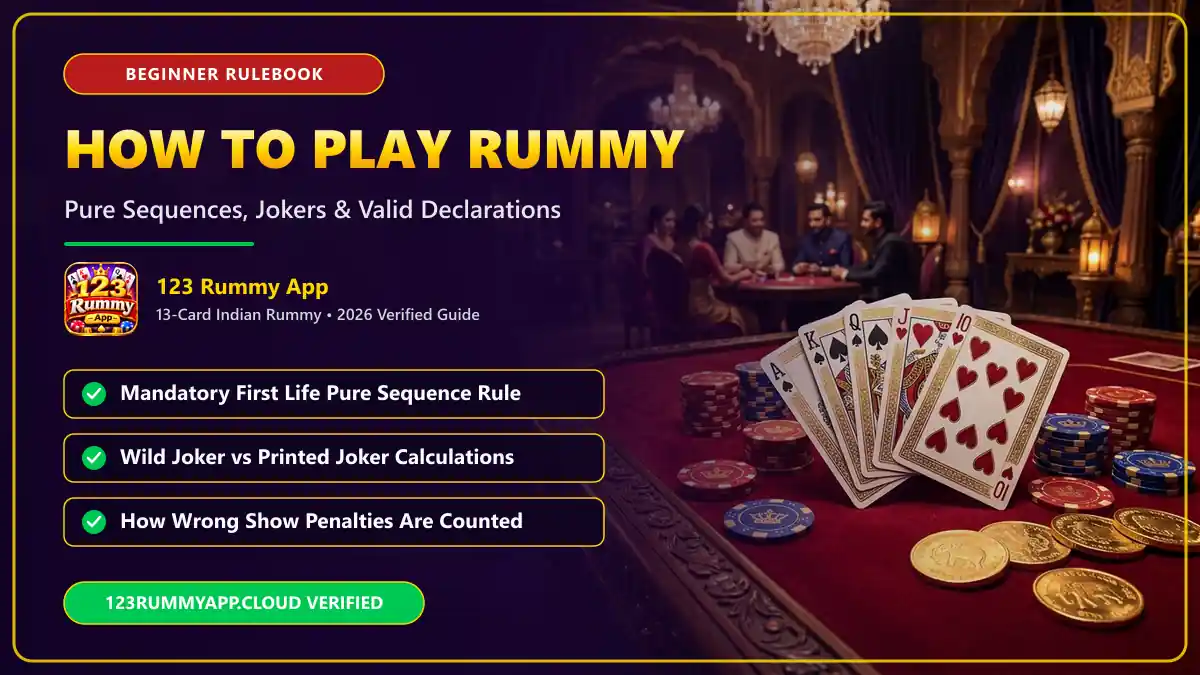
Thirteen cards fan out fast, and a 20-second turn timer vanishes quicker than beginners expect. Learning How to Play 123 Rummy cleanly starts with one single priority before checking sets or high cards: lock one pure sequence right away without touching any joker.
Once that clean three-card run sits green on screen, half your penalty risk drops immediately. New players entering How to Play 123 Rummy Game rooms rarely lose from unlucky cards alone; they swallow sudden 80-point losses because they hoard neat three-of-a-kind sets while skipping sequence laws under standard Indian rummy rules.
18+ Skill Gaming Guide | Check Local State Rules Before Playing
Core Objective Behind How to Play 123 Rummy
Classic 13 Card Rummy uses two shuffled 52-card decks plus printed jokers across two to six seated players. Each seat starts with 13 cards, one exposed card opens the Open Discard tray, and one cut card flips under the closed deck to pick that round’s Wild Joker rank.
To finish a deal in rummy card play, arrange all 13 cards into valid sequences and sets, draw your 14th card, then slide the spare unwanted card straight onto the Finish Slot to declare. Every winning declaration must clear three mandatory checks:
- Build at least two sequences among your groups.
- Make at least one Pure Sequence containing zero jokers.
- Group all remaining cards cleanly into valid sequences or sets with zero loose deadwood.
Pure Sequences, Impure Runs, and Valid Sets
Learning 123 Rummy Rules gets easy when comparing valid melds side by side. Notice why Pure Sequence Rummy overrides everything else in scoring:
Inspect row four carefully since double-deck play catches newcomers constantly. Two complete decks mean two Queens of Clubs circulate every round! Putting Q♣ beside Q♣ inside one Queen set fails server checks immediately and assigns a brutal 80-point wrong-show penalty! Remember too that Aces connect low (A 2 3) or high (Q K A) within one suit, yet wrapping K A 2 around the corner breaks the rules everywhere.

Printed and Wild Joker Calculation Rules
Flipping a random cut card under the deck keeps every hand fresh under certified RNG shuffling. Suppose 7♦ appears beneath the closed pile. Every 7♠, 7♥, 7♣, plus the remaining 7♦ inside both decks acts as a round Wild Joker worth zero deadwood penalty points if left unmelded!
Players practicing How to Play 123 Rummy smartly also spot a special diamond rule: connecting 6♦ 7♦ 8♦ naturally while 7 acts as Wild Joker still forms a valid Pure Sequence because 7♦ sits in its native suit order! Keep that natural pure run locked, then shift spare Wild Jokers onto heavy 10-point face-card groups holding Kings or Queens.
Step-by-Step Turn Flow Inside How to Play 123 Rummy
Every player turn moves cleanly through three repeating beats:
- Pick One Card: Draw either a mystery top card from the Closed Deck or the visible top card sitting inside Open Discard. Grabbing from Open Discard alerts watchful seats beside you regarding which ranks you are hunting.
- Sort & Shed High Points: Group adjacent same-suit connectors quickly via Auto-Sort and discard isolated face cards early when they lack neighbors.
- Discard or Finish Cleanly: Drop your unwanted 14th card onto Open Discard, or slide it onto the Finish box once all 13 cards light up green in valid melds.
Smart folding counts just as heavily inside How to Play 123 Rummy matches. Taking a First Drop right before your opening pick loses only 20 points instead of 80. Folding later via Middle Drop loses 40 points. Compare drop rules inside pro strategy tips, pick comfortable tables inside Game Modes, verify APK setup notes, or inspect Indian state rules on our Disclaimer page (referencing Indian gaming laws).

Four Complete 13-Card Hand Examples Scored Point by Point
Reading dry meld definitions gets you only halfway through your first match. Seeing four complete 13-card hands laid out side by side makes every law inside How to Play 123 Rummy click instantly, especially when a subtle double-deck trap turns a seemingly finished hand into an 80-point loss!
Assume the cut card flipped beneath the Closed Deck for every example below is 5♥, meaning every 5 across all four suits acts as a zero-point Wild Joker alongside Printed Jokers ([PJ]). Inspect all four complete 13-card spreads carefully before clicking Declare inside How to Play 123 Rummy rooms.
Valid Winning Declaration With 4 Groups (3+3+3+4 Split)
Look closely at Hand A and Hand B above while practicing How to Play 123 Rummy. Thirteen cards never divide cleanly into four threes; one group must carry four cards (4+3+3+3), or all thirteen can divide across three larger sequences (5+4+4 or 5+5+3)! Notice Hand B has zero three-of-a-kind sets yet still wins cleanly because two sequences (including one pure sequence) plus valid remaining runs satisfy every requirement under 13-card Indian rummy rules.
Spot one brilliant detail in Hand B too: 4♦ 5♦ 6♦ 7♦ 8♦ uses Wild Cut card 5♦ inside its own native Diamonds suit order, keeping that entire five-card group a rock-solid Pure Sequence (Pure Run examples)! Knowing that rule separates experienced regulars learning How to Play 123 Rummy from beginners who discard natural suited wild cards too quickly.
Common Invalid Hand That Scores Full 80 Deadwood Points
Now inspect Hand C and Hand D carefully because beginners swallow brutal losses on both shapes! Hand C holds massive Kings, Aces, plus two jokers yet zero Pure Sequence, turning every single meld invalid! Meanwhile Hand D repeats Q♣ twice inside one Queen set from double 52-card decks (double-deck duplicate trap), triggering an automatic 80-point Wrong Show penalty the moment you hit Declare in How to Play 123 Rummy lobbies.
Card Grouping, Auto-Sort, and Breaking Overlapping Runs
Tap Auto-Sort on Turn 1 to line suits up cleanly, then start thinking with your own eyes instead of freezing cards where software dropped them. One key habit inside How to Play 123 Rummy is recognizing when to break a four-card or five-card run to rescue stranded high cards nearby.
Imagine Auto-Sort arranges your hand as 4♠ 5♠ 6♠ 7♠ 8♠ beside unpaired 6♥ 6♦ plus loose K♣ Q♠ 9♥. On paper, a five-card spades run looks untouchable! Yet look at what happens when you slide 6♠ gently across onto 6♥ 6♦ 6♠: splitting 4♠ 5♠ plus 7♠ 8♠ leaves two broken two-card stubs instead of one pure run! You only split a 5-card run into a 3-card run plus set when three consecutive cards still stay pure, like splitting 4♠ 5♠ 6♠ 7♠ into 4♠ 5♠ 6♠ (still a Pure 3-card run) while freeing 7♠ onto 7♥ 7♦ 7♠.
When to Split a Five-Card Natural Sequence
Check our sequence splitting guide for four exact situations where breaking a 4-card or 6-card run turns deadwood into an instant Finish! Always verify after any split that at least three consecutive same-suit cards remain untouched inside your First Life pure sequence before confirming melds in How to Play 123 Rummy matches.
Using Auto-Sort Without Missing Dual-Use Connectors
Auto-Sort places cards by suit first, which occasionally hides strong three-of-a-kind sets sitting spread across multiple suits! Train yourself inside How to Play 123 Rummy rooms to scan ranks horizontally after sorting by suit (Auto-Sort workflow). Spotting an extra pair of 8s or Queens spread across three suits takes two seconds and saves key turns (fast sorting drills).
Declare Button Mechanics, Wrong Show Penalties, and Drops
Winning turns end awkwardly for hundreds of newcomers because they confuse the Discard box with the Finish Slot. In digital How to Play 123 Rummy lobbies, you draw card #14 to hold 14 cards temporarily, check that 13 cards group into green valid melds, and drag your final unwanted card deliberately onto the central Finish Slot box rather than tossing it onto the Open Discard pile!
Once card #14 enters the Finish Slot, a countdown confirmation window opens showing all your grouped cards. Do one calm final suit-check across sets for double-deck duplicates, check that Pure Sequence carries a green pure badge, and tap Declare cleanly while playing How to Play 123 Rummy rounds.
Avoiding the Accidental Open Discard Tap on Card #14
If your finger slips and drops your 14th card onto Open Discard instead of Finish Slot, the round continues immediately without declaring you winner! Worse yet, if your remaining 13 cards already sit in 4-3-3-3 finished melds, you now hold 13 melded cards waiting an entire extra 6-player rotation just to draw and discard again while opponents race to beat you to Finish! Slow down for half a second on your winning turn inside How to Play 123 Rummy tables.
How Auto-Play Timeout Counts Missed Turns
Watch the 20-second vertical turn bar tightly on every turn. If cellular signal stalls or you step away without hitting Drop, three consecutive missed turns trigger an automatic 40-point Middle Drop penalty and remove you from that hand (timeout penalty rules). Always tap First Drop proactively on hopeless Turn 1 hands before stepping away (First vs Middle Drop math) whenever mastering How to Play 123 Rummy timing.
How Unmelded Cards Convert Into Rupees Across Tables
Scoring rules stay identical across all lobbies in How to Play 123 Rummy, yet the way your deadwood points translate into cash changes drastically across Points, Pool, plus Deals. Knowing exact deadwood weights helps you cut risk cleanly whenever an opponent looks one card away from Finish.
Number cards from 2 through 10 carry their face value (a 7♣ counts 7 points). Face cards plus Aces each weigh 10 penalty points! Both Printed Jokers plus the round Cut Wild Joker carry 0 penalty points even when sitting loose by themselves, and losing hands cap cleanly at 80 points maximum regardless of how many unmelded face cards sit in your fan inside How to Play 123 Rummy sessions.
Deadwood Addition for Number Cards, Face Cards, and Jokers
Suppose you already locked one Pure Sequence (4♠ 5♠ 6♠) plus one Impure Sequence (8♥ 9♥ [PJ]) when an opponent declares. Your remaining unmelded cards read A♦ (10 pts) + K♣ (10 pts) + 9♥ (9 pts) + 4♣ (4 pts) + 2♠ (2 pts) = 35 penalty points! Having both mandatory sequences locked saved you 45 points compared to a full 80-point wipeout.
How Points Rummy, 101 Pool, and Deals Score the Same Hand
See how that exact 35-point loss hits three different game formats inside How to Play 123 Rummy:
- ₹0.50/pt Points Table: You immediately pay 35 multiplied by ₹0.50 = ₹17.50 out of your table chip stack, then deal fresh right away.
- 101 Pool Match: Your cumulative match total adds +35 points toward the 101-point elimination ceiling without deducting extra rupees beyond your match entry fee.
- 2-Deal Match: Your 160 starting tournament chips drop by 35 down to 125 chips, while the winner climbs from 160 to 195 chips heading into Deal 2!
Verify any hand combination instantly inside our Rummy Points Calculator, browse every term inside the Rummy Glossary, and build calm turn speed inside free chip practice rooms before trying cash play under How to Play 123 Rummy guides.
Ready to Practice Pro Discard Reading?
Move beyond basic meld rules with our 7 habits on 20-point drops, middle connectors, and opponent tracking.
Explore Winning Tips NextBeginner Questions on 13-Card Play
How many penalty points do Aces and Kings carry in How to Play 123 Rummy?
Aces, Kings, Queens, and Jacks each count 10 penalty points when unmelded at a loss, capped at 80 maximum points per round.
Can K A 2 of Hearts form a valid Pure Sequence?
No. Aces anchor either A 2 3 or Q K A of one suit, never wrapping across King to 2.
Does a sequence made with two Printed Jokers plus one card count as Pure?
No. Pure sequences never permit printed or cut-card jokers, whereas your second sequence may freely include jokers.
What happens if I tap Declare with an invalid double-suit Queen set?
Wrong declarations end the hand immediately for you with the maximum 80-point penalty in Points rummy or full Pool table penalty.
Can a player finish legally under How to Play 123 Rummy rules using only three sequences and zero sets?
Yes! You can declare validly with zero sets as long as your 13 cards divide into at least two sequences (one strictly Pure) and all remaining cards sit inside valid sequences.
What happens under How to Play 123 Rummy if the Closed Deck runs empty before anyone declares?
In standard Indian 13-card rummy software, discarded cards beneath the top Open card automatically reshuffle cleanly to replenish the Closed Deck so play continues smoothly.
Can I pick the very first card placed face up on the Open Pile at the start of Turn 1 in How to Play 123 Rummy?
Yes, picking the initial exposed card on Turn 1 counts as your opening draw, provided you discard one unwanted card afterwards without taking First Drop.
Why does missing three consecutive turns in How to Play 123 Rummy cost 40 points instead of 20 points?
Once a player misses opening turns or allows the timer to run out thrice after cards deal, servers treat the forced exit as a Middle Drop carrying a 40-point penalty.