
Bank Penny Drop Check catches thousands of players off guard when they notice an unexpected ₹1.00 or ₹1.05 credit pinging their SBI or HDFC phone SMS seconds after adding payout details on 123 Rummy App! That tiny deposit is not free promo cash, because it represents automated bank beneficiary identity checking protecting wallets against typo-routed withdrawals.
Knowing how KYC banking validation runs penny-drop probes prevents joint-account holds before requesting actual cash profits.
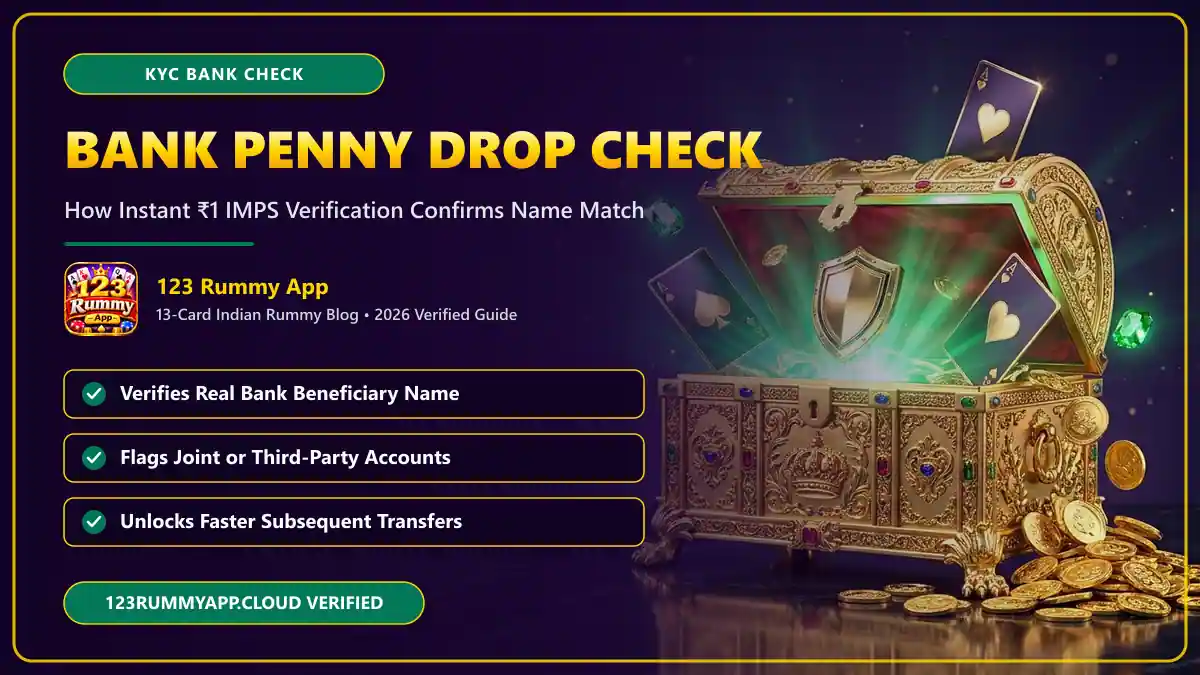
- 1. How NPCI Returns Exact Account Owner Strings
- 2. Blocking Typo Transfers & Unauthorized Withdrawals
- 3. Watch Joint Family Accounts & Initial Abbreviations
- 4. Clean Verification Enables Fast Future Settlements
- Comparing Re 1 Verification IMPS vs Penniless APIs
- Behind the Scenes of KYC Bank Match Scoring Thresholds
- Diagnosing Failed Bank Penny Drop Check Error Messages
- Five-Minute Bank Setup to Prevent Payout Hold Issues
- 5. Penny Drop Verification Questions
Technical Flow Behind Bank Penny Drop Check
How can any gaming website magically read the true full legal name printed on your private Bank of Baroda savings ledger before sending ₹25,000? Enter NPCI’s standard Bank Penny Drop Check API! The verification gateway dispatches an automated ₹1.00 IMPS/UPI ping targeting your entered Account Number + IFSC cleanly.
Upon accepting that Re 1 credit (IMPS beneficiary response strings), your bank switches return a verification string containing exact Account Status (Active/Closed) AND your legally recorded Account Holder Name, comparing it directly against your uploaded PAN KYC name within seconds! This real-time API handshake happens entirely over regulated interbank payment rails.
Preventing Irreversible Wrong-Account Payouts
Imagine manually fat-fingering one digit inside an 11-digit SBI account string right while initiating a ₹5,000 cashout! Without Bank Penny Drop Check validating names first, ₹5,000 could fire permanently into a random stranger’s savings account with practically zero reversal recourse! Catching mismatches cheaply via Re 1 verification shields players cleanly from heartbreaking typing losses and blocks unauthorized third-party withdrawals instantly.

Hidden Mismatches: Joint Ledgers & Spouse VPAs
Two sneaky flags trip honest Indian families constantly during automated Bank Penny Drop Check scans:
- Joint Accounts: Primary account holder sitting #1 defaults onto returned NPCI strings, so if your spouse appears first ahead of your PAN name, validation bounces cleanly!
- Compressed Passbook Initials: Bank strings reading “S K GUPTA” fail strict matching against PAN strings reading “SANJAY KUMAR GUPTA” (check exact spelling fixes).
Linking an individual personal savings ledger in your exact PAN spelling avoids nearly every frustrating validation rejection cleanly.
18+ Skill Gaming Guide | Check Local State Rules Before Playing

Clear Penny Checks Before Your First Cash Table Win
Verify bank details cleanly right on day one rather than waiting until Sunday midnight after a big tournament score! Passing your Bank Penny Drop Check stores your verified bank securely for fast downstream IMPS or UPI settlements while honoring safe Responsible Gaming limits.
Once green verified status appears inside Cashier, future payout clicks route immediately without repeating manual checks unless you swap bank accounts.

How Re 1 Verification IMPS Compares With Penniless API Checks
Every regulated Indian gaming cashier verifies who really owns the receiving bank account before releasing prize money. Across Indian fintech and gaming infrastructure in 2026, payment partners execute that Bank Penny Drop Check using two distinct NPCI clearing methods: traditional Re 1 Verification IMPS and newer penniless validation APIs.
Under classic Re 1 Verification IMPS, the payout aggregator fires a real ₹1.00 (occasionally ₹1.02 or ₹1.05 to avoid duplicate identical-amount filters) IMPS credit toward your submitted Account Number and 11-character IFSC. Your bank’s Core Banking System processes that credit, triggers a genuine ₹1 SMS deposit alert on your mobile phone, and echoes back your exact legally recorded beneficiary string! Under newer penniless validation (widely supported on UPI VPA verification and select NPCI bank nodes), the API queries the bank switch for status and legal account holder spelling without transferring ₹1 into your savings balance.
Why do many rummy platforms still rely on the ₹1 Bank Penny Drop Check for IFSC accounts? Because several regional cooperative banks, older public-sector branch nodes, and rural bank gateways return cleaner beneficiary strings over live IMPS credit legs than penniless lookup calls.
Both methods serve one single goal under strict Name Verification Rummy compliance: ensuring the human holding the verified PAN card matches the person owning the receiving bank account cleanly before real cash leaves Cashier. Even when a ₹1 credit feels surprising on your phone SMS, that micro-transfer protects your payout against mistyped account numbers permanently. Learn more inside our complete KYC verification checklist so your initial account link clears in three seconds flat.
Behind the Scenes of KYC Bank Match Scoring Thresholds
Understanding how automated verification parsers grade spelling gaps removes nearly all frustration around unexpected holds. Whenever your Bank Penny Drop Check returns a beneficiary string from SBI, HDFC, ICICI, or Bank of Baroda, a fuzzy matching engine compares that bank string letter by letter against your verified NSDL PAN string to score your KYC Bank Match percentage.
Exact Word Swap vs Dropped Middle Names
Suppose your PAN card reads RAJESH KUMAR SHARMA. If your HDFC savings account prints SHARMA RAJESH KUMAR, modern token-sort matching scores 100% parity and approves the link instantaneously! Even dropping a common middle name (“RAJESH SHARMA” vs “RAJESH KUMAR SHARMA”) often clears automated thresholds around 82% to 88% on lenient rulesets, though stricter payouts flag dropped middle words for a quick manual passbook review.
Handling Honorifics Like Mr, Mrs, Smt, and Sri
Old savings accounts opened ten years ago frequently store bank records with prefixes baked right inside the account title, such as MR. RAJESH SHARMA, SMT. KAVITA DEVI, or KUMARI ANITA VERMA. Standard banking parsers automatically strip common honorifics (Mr, Ms, Mrs, Shri, Smt, Dr) before scoring your Bank Penny Drop Check, so honorific prefixes rarely stall verification on reputable apps.
Regional Bank String Truncation Beyond 20 Characters
Watch out for a hidden legacy quirk across older Core Banking systems! Some cooperative banks and regional rural bank switches limit IMPS beneficiary return strings to 20 or 25 characters, slicing VENKATASUBRAMANIAN KRISHNAMURTHY off halfway as VENKATASUBRAMANIAN KR! When character truncation lowers your automated KYC Bank Match score below 75%, your verification falls back into manual review (read name mismatch resolution steps). Linking a major full-length digital savings account solves character truncation permanently.
Handling Single-Word Names on Older PAN Records
Some Indian citizens hold single-word names like DEEPAK or HARPREET on older bank ledgers while NSDL PAN records split or repeat the string as DEEPAK DEEPAK. Whenever automated scoring hesitates on single-word titles, uploading your printed passbook front page inside official in-app support resolves the check safely within one working day. Keeping one crystal-clear bank profile aligned with PAN eliminates nearly every manual compliance queue later.
Diagnosing Failed Bank Penny Drop Check Error Messages
Seeing “Bank Verification Failed” immediately after typing your account digits correctly feels baffling until you check which banking edge case triggered the rejection. Five specific technical flags account for nearly every failed Bank Penny Drop Check across India, and checking them saves hours of support back-and-forth.
Dormant, Inoperative, or Frozen Zero-Balance Accounts
If a student savings account or secondary Jan Dhan ledger saw zero user-initiated transactions for over 24 months, banks mark it Inoperative or Dormant under RBI guidelines. Similarly, accounts missing recent periodic Re-KYC updates carry credit freezes! Whenever the platform runs a Bank Penny Drop Check against an inactive or KYC-frozen account, the receiving bank bounces the ₹1 IMPS ping back with an Account Blocked or Dormant error.
Pre-Merger IFSC Strings From Legacy Public Banks
India merged multiple public sector banks across recent consolidation waves, retiring thousands of legacy branch codes. Entering an old Syndicate Bank IFSC instead of the updated Canara Bank code, an old Allahabad Bank code instead of Indian Bank, or a legacy OBC or United Bank code instead of Punjab National Bank causes the verification API to fail immediately with Invalid IFSC. Check your active mobile banking passbook screen rather than an old paper passbook printed years ago.
NRE and NRO NRI Accounts Blocking Domestic Gaming Credits
Indian gaming wallets operate strictly in resident Indian rupees under domestic skill-gaming rules. Submitting an NRE (Non-Resident External) or NRO savings account causes banks to bounce commercial gaming credits and fail automated Bank Penny Drop Check validation! Use only an active resident Indian savings account matching your personal Indian PAN card.
Daily Attempt Rate Limits and Cooling Locks
Repeatedly mistyping an 11-character IFSC or testing three different family members’ account numbers trips anti-fraud velocity limits! After 3 to 5 failed bank check attempts inside 24 hours, security filters temporarily lock bank addition for 24 hours to block brute-force account probing. Pause and verify every digit carefully on your bank statement before tapping Submit once.
Checking Paytm, Airtel, and Neo-Bank Payment Rails
Players occasionally try linking older wallet-style payments banks or promotional neo-bank virtual accounts that underwent RBI onboarding restrictions. Before linking a secondary virtual account, check whether your mobile banking app confirms active two-way IMPS inbound support. Choosing a full-schedule commercial bank guarantees high verification success across weekend and holiday queues alike.
Five-Minute Bank Setup to Prevent Payout Hold Issues
Completing your banking link cleanly before your first paid match saves stress on weekend nights when you actually want to withdraw profits. Follow this five-minute sequence to Prevent Payout Hold delays completely under every Bank Penny Drop Check standard:
- Verify Your PAN Card First: Confirm your PAN verification profile shows Approved status and note the exact spelling recorded inside the app profile.
- Inspect Netbanking Beneficiary Title, Not Nickname: Open your bank’s official mobile app -> Account Details -> Account Holder Name rather than relying on a casual debit card imprint or UPI app nickname. Verify that full spelling aligns cleanly before starting the Bank Penny Drop Check.
- Pick a Single-Holder Resident Savings Account: Avoid joint family accounts where another relative sits as Primary Holder #1, avoid current business accounts tied to GST entity names, and stick strictly to major schedule banks supporting clean 24×7 IMPS vs UPI payout routing.
- Run One Clean Verification Test During Banking Hours: Submit your Account Number and updated IFSC once on a weekday daytime window, confirm the ₹1 credit SMS arrives within seconds, and check for the green Verified badge inside Cashier.
- Protect Account Hygiene Long Term: Never link the same savings account onto a sibling’s gaming profile (avoid multi-account collusion flags) and keep play balanced under responsible gaming limits. Taking five minutes upfront to clear verification ensures every future withdrawal flows cleanly straight to your savings account.
Checking full withdrawal verification guidelines before loading your first tournament deposit keeps both bank account validation and future cashouts completely smooth.
Comparing Direct Bank Account Verification Against UPI VPA Checks
Many Indian players ask whether verifying a UPI VPA handle skips the ₹1 Bank Penny Drop Check entirely. In practice, regulated cashiers validate BOTH channels cleanly behind the scenes! When you enter an Account Number plus 11-character IFSC, the gateway fires a ₹1 IMPS ping; when you link a PhonePe or Google Pay VPA, the gateway either executes a penniless NPCI lookup or a ₹1 UPI check returning the underlying bank account holder name!
Passing your initial Bank Penny Drop Check on a clean primary savings account sets up smooth withdrawals across both payment rails, avoiding frustrating Sunday night verification holds when prize pots settle cleanly into savings.
Always save the ₹1 verification SMS or reference ID inside your phone notes too, because that micro-credit proves your bank route works smoothly ahead of real withdrawals.
Fixing PAN Initial Spelling Differences Cleanly
Solve mismatches between “R. K. Sharma” on passbooks and “Rakesh Kumar Sharma” on your PAN card fast.
Read Name Mismatch FixesPenny Drop Verification Questions
Do I have to refund the Re 1 sent via Bank Penny Drop Check?
No! Platforms absorb that tiny ₹1.00 Bank Penny Drop Check validation credit outright as verification infrastructure overhead.
Why did Bank Penny Drop Check say Failed even though my Savings Account has plenty of money?
Usually wrong merged-bank IFSC codes, typing spaces inside account strings, or temporary core-bank maintenance windows trigger failure.
Can I link a Paytm Payments Bank, Airtel Payments Bank, or Kotak 811 zero-balance account?
Wait carefully: verify current RBI active payout eligibility on niche payments banks, whereas major full-schedule Indian banks (SBI, HDFC, ICICI, Axis, PNB, Kotak) clear cleanly under Bank Penny Drop Check rules!
How many tries do platforms allow before locking wrong Bank Penny Drop Check attempts?
Most security systems pause retry entry after 3 to 5 consecutive mismatches inside 24 hours to block brute-force bank probing.
Why did my bank SMS show ₹1.02 or ₹1.05 during a Bank Penny Drop Check instead of ₹1.00?
Some payment gateways randomize the fractional paise amount between ₹1.00 and ₹1.05 so two consecutive verification pings do not trip duplicate-transaction bank filters on the same day. You keep that tiny verification credit with zero refund needed.
Can I link a Current Account or Proprietorship Account for Bank Penny Drop Check?
No! Proprietorship or Current accounts frequently return the business trade name (such as “Sharma Traders”) instead of your personal PAN legal name, causing automated KYC Bank Match validation to fail immediately. Stick strictly to a personal resident Savings Account.
Will an NRE or NRO bank account pass Bank Penny Drop Check on Indian rummy apps?
No. Indian real-money skill apps support resident Indian rupee accounts only; NRE and NRO bank accounts block commercial domestic gaming settlements and fail automated verification.
Does changing my linked bank later require a fresh Bank Penny Drop Check?
Yes! Whenever you add a secondary savings account or swap your primary payout bank inside Cashier, the platform triggers a fresh Bank Penny Drop Check (₹1 IMPS or penniless verify) to confirm your PAN matches the newly linked account.